
I purchased an EV in 2026 feeling great that I would be saving $$$ while oil prices are soaring. After driving and charging my modern non-Tesla EV for a few weeks, I found out that there was way too much energy waste with Level 1 charging.
Level 1 Charging Efficiency Claimed on the Internet
If you ask Google or AI on Level 1 charging efficiency, it typically says 70-80% efficiency for Level 1 charging (some even say 80-90% efficient) and around 90% charging for Level 2. I roughly trusted that amount before buying an EV and it seemed most people on the internet or Reddit seemed to quote that a lot or even mentioned the measurement / conditions were wrong if it was lower than that.
This could not be further than the actual truth. Here’s why:
Level 1 Charging at 12 Amps
Level 1 charging is typically done at 120 volts at a current of 12A. It is possible to charge at 120v 16 amps if you have a 20 amp power outlet but the majority of homes in the US would have a regular 15 amp, making 12A the safe charge limit for Level 1 charging at home. (please see https://www.wikihow.com/15-Amp-vs-20-Amp-Outlet for details)
This is the power consumption on my basic charger that has an app:
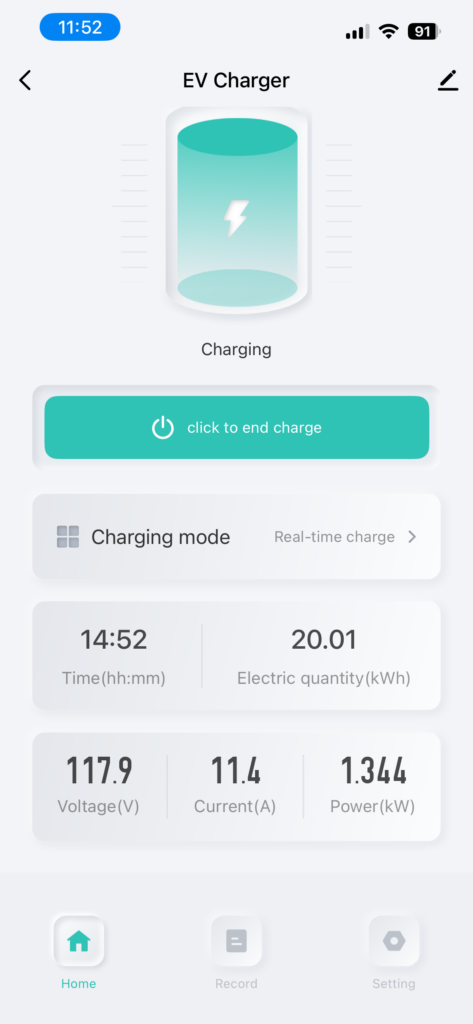
Theoretically, this would be 120 x 12 = 1440 watts of charging but a Level 1 charger charges slightly lower than 12 amps, in my case around 11.4A @ 118 volts, so that would make charging power usage at around 118 x 11.4 = 1,345 watts.
Major Inefficiency for Level 1 Charging
However, I was pretty puzzled when the EV charging screen said the car was charging at 900 watts. I expected it would be well over 1000 watts but it just wasn’t around there. It turns out, to charge the battery effectively, the EV’s ICCU (Integrated Charging Control Unit) uses up a lot of power to condition the battery and charge it. And it uses a LOT more power than you think – about 450 watts (likely a combination of control, heat and transfer loss).
So according to what the EV says it is charging the battery at, the efficiency seems to be calculated at 900w / 1,356w x 100 (charge rate divided by the power used x 100) which turns out to be a 66.37% efficiency. This is clearly below the 70% to 80% efficiency mentioned, just to start with.
But It Doesn’t Stop There!
There is more…. just because your EV tells you your battery is charging at 900 watts doesn’t mean that 100% of that power is stored in your battery. By dividing the total watts the battery was charged by the number of hours it took to charge it, based on a 15 hour charge (11.17kWh / 15), I came to a number of about 745 watts of actual battery charging. So we are losing about another 150 watts of charging loss in addition to the ICCU loss here.
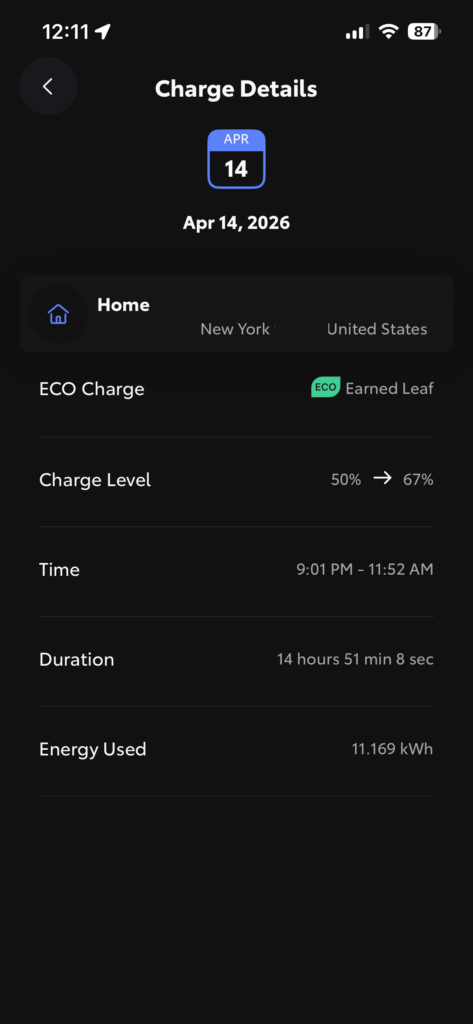
If you combine those 2 losses, loss from the ICCU and loss from the actual charging, I was only getting a charge of 745 watts while consuming (or paying for) 1,345 watts of energy. 745 watts / 1,345 watts x 100 = 55.39% efficiency!
The Internet Numbers Don’t Add Up
The internet claims Level 1 charging is 70-80% efficient. Perhaps this is purely the efficiency of the power that goes into the battery after the ICCU and not the power used by the ICCU itself. But one thing for sure is that the common information out there on Level 1 charging is very misleading and needs to be corrected. Please take your own measurements to come up with a number that you can share. This was based on a Toyota made EV and I assume Toyota would know a thing or 2 about batteries and charging so I wouldn’t necessarily point out my EV make, model or quality.
It’s Worse in Colder Weather
I did not test this in freezing weather. If the heat pump kicks in to generate heat to warm up the battery, the efficiency is expected to drop far below 50% when charging in cold winter weathers. Does this match your charging experience in winter?
What Are Your Numbers?
Please share them in the comments below while I go through my measurements and calculations on Level 2 charging as comparison!